Your How are memories stored in the brain images are ready in this website. How are memories stored in the brain are a topic that is being searched for and liked by netizens today. You can Get the How are memories stored in the brain files here. Download all royalty-free vectors.
If you’re looking for how are memories stored in the brain images information connected with to the how are memories stored in the brain topic, you have pay a visit to the ideal site. Our site always provides you with suggestions for downloading the highest quality video and image content, please kindly hunt and locate more informative video content and graphics that fit your interests.
How Are Memories Stored In The Brain. When it comes to storing or making a memory Hippocampus is involved. They are widely distributed throughout the cortex and neurons. There are three areas of the brain involved in explicit memory. As for long-term memory it is essentially caused by chemical changes in synapses between neurons in the brain.
 Here S How The Brain Makes Memories And What You Can Do To Keep Your Mind Sharp Brain Facts Medical Knowledge Medical Education From pinterest.com
Hippocampus is the main region of the brain involved in memory processes. When it comes to storing or making a memory Hippocampus is involved. With advancing imaging techniques research has focused once again on pinpointing where in the brain memories are stored. Memories stored long-term are stored in all parts of the brain. As for long-term memory it is essentially caused by chemical changes in synapses between neurons in the brain. Studies suggest that the brain does not store memories in complete exact recollections which can simply be retrieved.
Short-term memories like a possible chess move or a hotel room number are processed in the front of the brain in.
There are three areas of the brain involved in explicit memory. Howard Eichenbaum has published a new study suggesting that the circuitry in the human brain that retrieves memories appropriate for specific situations spans long distances and supports a complex dialog between two brain structures. There are two areas of the brain involved in implicit memory. When it comes to storing or making a memory Hippocampus is involved. Over 130 years ago pioneering neuroscientist Santiago Ramón y Cajal. Indeed when people attempt to learn new associations and recall them later those whose hippocampus generated the most activity.
 Source: pinterest.com
Over 130 years ago the pioneering neuroscientist Santiago Ramón y Cajal first suggested that the brain store information by rearranging the connections or synapses between neurons. All memory storage devices from your brain to the RAM in your computer store information by changing their physical qualities. The hippocampus the neo-cortex and the. If it lasts your entire lifetime it must be stored by a durable mechanism He thinks its probably stored by changing the wiring of the brain itself changing connectivity patterns which enable long-term information storage. One way in which working memory is stored is by keeping neural circuits that encode the remembered items active.
 Source: pinterest.com
This may be seen as the physiological analogue of repeating mentally the items we. All memory storage devices from your brain to the RAM in your computer store information by changing their physical qualities. Over 130 years ago pioneering neuroscientist Santiago Ramón y Cajal. Specialized software developed by the research team creates a map of the specific location and size. Rather memories are stored in small pieces and scattered across different parts of your brain.
 Source: pinterest.com
It is the primary regulator of the process of memory retention. The brain stores memories in two ways. There are three areas of the brain involved in explicit memory. Memories stored long-term are stored in all parts of the brain. One way in which working memory is stored is by keeping neural circuits that encode the remembered items active.
 Source: pinterest.com
If true we can. It is the primary regulator of the process of memory retention. When you sense stimuli from your environment action potentials follow a specific trail of afferent neurons towards the central nervous system which then sends a message back through efferent neurons to initiate a response. Over 130 years ago pioneering neuroscientist Santiago Ramón y Cajal. Rather memories are stored in small pieces and scattered across different parts of your brain.
 Source: pinterest.com
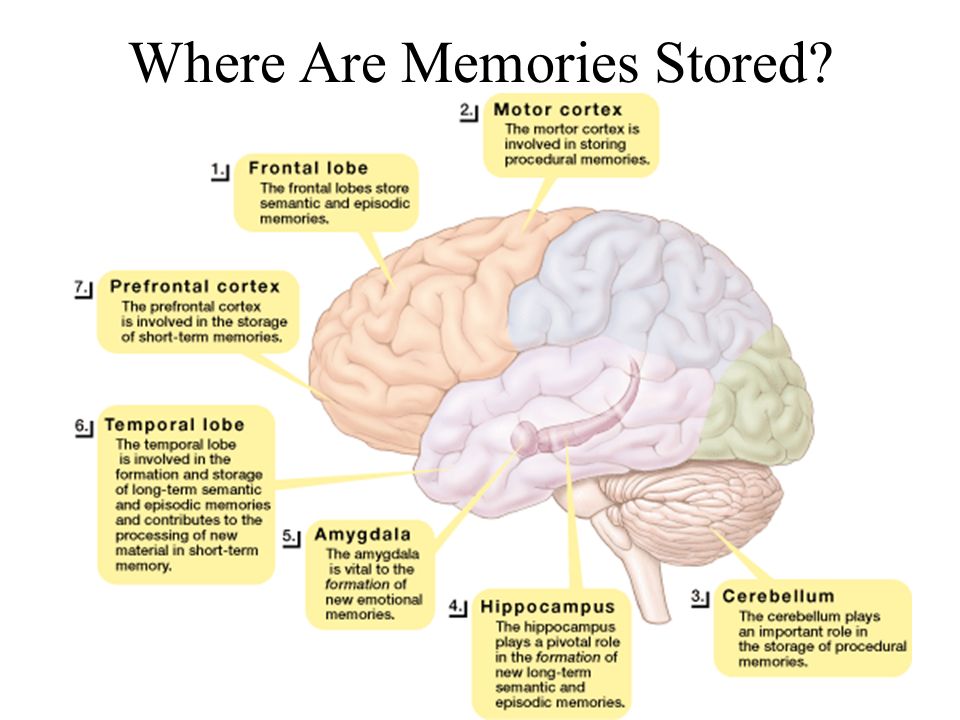
The parts of the brain which serve as information processors to create memories and store them include the prefrontal cortex neocortex basal ganglia cerebellum hippocampus and amygdala. The parts of the brain which serve as information processors to create memories and store them include the prefrontal cortex neocortex basal ganglia cerebellum hippocampus and amygdala. All memory storage devices from your brain to the RAM in your computer store information by changing their physical qualities. All memory storage devices from your brain to the RAM in your computer store information by changing their physical qualities. The hippocampus the neo-cortex and the.
 Source: pinterest.com
Over 130 years ago pioneering neuroscientist Santiago Ramón y Cajal. All memory storage devices from your brain to the RAM in your computer store information by changing their physical qualities. Where are memories stored in the brain. The brain stores memories in two ways. This may be seen as the physiological analogue of repeating mentally the items we.
 Source: pinterest.com
Over 130 years ago pioneering neuroscientist Santiago Ramón y Cajal. In the 1920s the behavioral psychologist Karl Lashley conducted a now famous series of experiments in an attempt to identify the part of the brain in which memories are stored. This may be seen as the physiological analogue of repeating mentally the items we. All memory storage devices from your brain to the RAM in your computer store information by changing their physical qualities. The basal ganglia and the cerebellum.
 Source: in.pinterest.com
Storage is the second step in memory creation. When you sense stimuli from your environment action potentials follow a specific trail of afferent neurons towards the central nervous system which then sends a message back through efferent neurons to initiate a response. Female brain computer artwork. There are two areas of the brain involved in implicit memory. We now know that the hippocampus springs into action to glue different aspects of a single memory together.
Source: pinterest.com
When it comes to storing or making a memory Hippocampus is involved. When it comes to storing or making a memory Hippocampus is involved. All memory storage devices from your brain to the RAM in your computer store information by changing their physical qualities. Rather memories are stored in small pieces and scattered across different parts of your brain. We now know that the hippocampus springs into action to glue different aspects of a single memory together.
 Source: no.pinterest.com
Over 130 years ago pioneering neuroscientist Santiago Ramón y Cajal. Studies suggest that the brain does not store memories in complete exact recollections which can simply be retrieved. Once a memory is stored in the long-term memory it is there even though you. All memory storage devices from your brain to the RAM in your computer store information by changing their physical qualities. Specialized software developed by the research team creates a map of the specific location and size.
 Source: pinterest.com
Over 130 years ago the pioneering neuroscientist Santiago Ramón y Cajal first suggested that the brain store information by rearranging the connections or synapses between neurons. We now know that the hippocampus springs into action to glue different aspects of a single memory together. As for long-term memory it is essentially caused by chemical changes in synapses between neurons in the brain. They are widely distributed throughout the cortex and neurons. Over 130 years ago pioneering neuroscientist Santiago Ramón y Cajal.
 Source: pinterest.com
If true we can. Memories stored long-term are stored in all parts of the brain. Storage is the second step in memory creation. There are three areas of the brain involved in explicit memory. Over 130 years ago the pioneering neuroscientist Santiago Ramón y Cajal first suggested that the brain store information by rearranging the connections or synapses between neurons.
 Source: in.pinterest.com
Study shows how memories are stored in the brain with potential impact on conditions like PTSD. A team of USC researchers has for the first time answered this question by inducing a memory in a larval zebrafish and then mapping changes in their transparent heads with brain cells lit up like Times Square on New Years Eve. All memory storage devices from your brain to the RAM in your computer store information by changing their physical qualities. This means we may be storing memory within microanatomical patterns rather than just the strength of synapses Ryan says. All memory storage devices from your brain to the RAM in your computer store information by changing their physical qualities.
 Source: pinterest.com
One way in which working memory is stored is by keeping neural circuits that encode the remembered items active. All memory storage devices from your brain to the RAM in your computer store information by changing their physical qualities. We now know that the hippocampus springs into action to glue different aspects of a single memory together. Over 130 years ago the pioneering neuroscientist Santiago Ramón y Cajal first suggested that the brain store information by rearranging the connections or synapses between neurons. All memory storage devices from your brain to the RAM in your computer store information by changing their physical qualities.
 Source: pinterest.com
Over 130 years ago pioneering neuroscientist Santiago Ramón y Cajal. Storage is the second step in memory creation. As for long-term memory it is essentially caused by chemical changes in synapses between neurons in the brain. Over 130 years ago pioneering neuroscientist Santiago Ramón y Cajal. Studies suggest that the brain does not store memories in complete exact recollections which can simply be retrieved.
 Source: pinterest.com
Over 130 years ago the pioneering neuroscientist Santiago Ramón y Cajal first suggested that the brain store information by rearranging the connections or synapses between neurons. The hippocampus the neo-cortex and the. Over 130 years ago pioneering neuroscientist Santiago Ramón y Cajal. All memory storage devices from your brain to the RAM in your computer store information by changing their physical qualities. Howard Eichenbaum has published a new study suggesting that the circuitry in the human brain that retrieves memories appropriate for specific situations spans long distances and supports a complex dialog between two brain structures.
 Source: pinterest.com
Specialized software developed by the research team creates a map of the specific location and size. All memory storage devices from your brain to the RAM in your computer store information by changing their physical qualities. All memory storage devices from your brain to the RAM in your computer store information by changing their physical qualities. Where are memories stored in the brain. The brain stores memories in two ways.
 Source: pinterest.com
The basal ganglia and the cerebellum. The parts of the brain which serve as information processors to create memories and store them include the prefrontal cortex neocortex basal ganglia cerebellum hippocampus and amygdala. Hippocampus is the main region of the brain involved in memory processes. Study shows how memories are stored in the brain with potential impact on conditions like PTSD. It is the primary regulator of the process of memory retention.
This site is an open community for users to do submittion their favorite wallpapers on the internet, all images or pictures in this website are for personal wallpaper use only, it is stricly prohibited to use this wallpaper for commercial purposes, if you are the author and find this image is shared without your permission, please kindly raise a DMCA report to Us.
If you find this site serviceableness, please support us by sharing this posts to your favorite social media accounts like Facebook, Instagram and so on or you can also bookmark this blog page with the title how are memories stored in the brain by using Ctrl + D for devices a laptop with a Windows operating system or Command + D for laptops with an Apple operating system. If you use a smartphone, you can also use the drawer menu of the browser you are using. Whether it’s a Windows, Mac, iOS or Android operating system, you will still be able to bookmark this website.


